

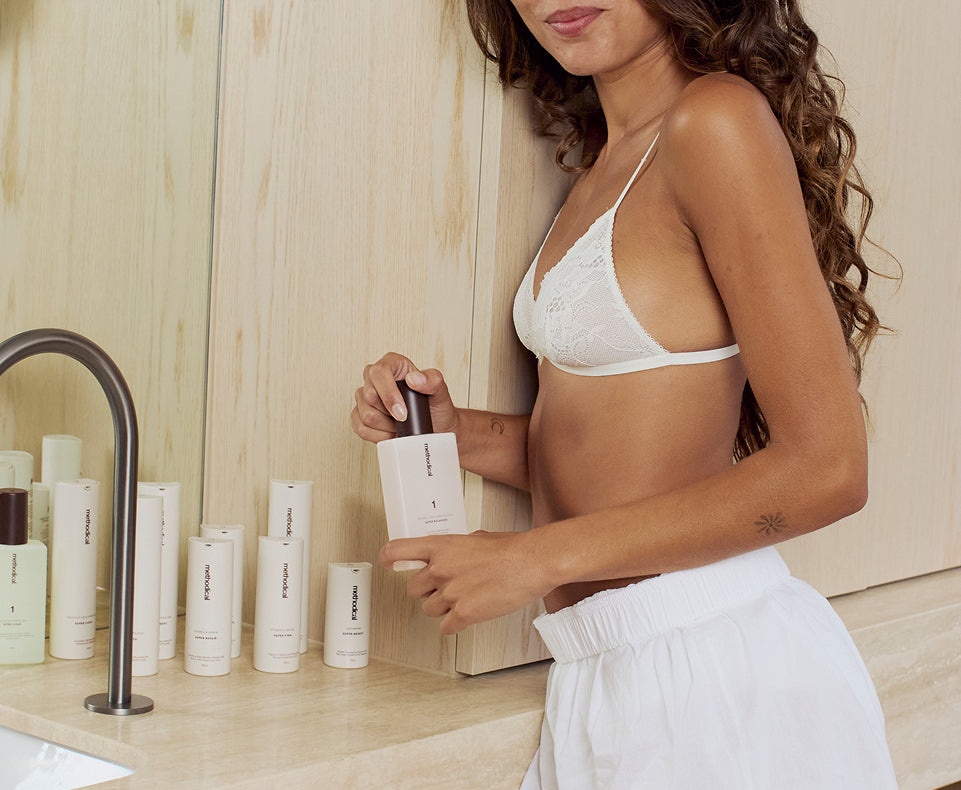
How to Build a Skincare Routine That Actually Works: The Methodical Method
By Dr Ceylan Yilmaz, Cosmetic Doctor & Medicinal Chemist
Part 1 of 3 in the Methodical guide to building a skincare routine: the framework and the steps.
In my clinic, I meet a lot of people who have spent thousands of dollars on skincare and still aren’t happy with their skin. They have shelves of serums, three cleansers, two retinols, and a moisturiser they bought because an influencer told them to. What they don’t have is a routine; they have a collection.
That gap is what this article is about. Building a skincare routine isn’t about adding more products. It’s about understanding what your skin actually needs, then doing the smallest number of things that meet those needs really well. Done properly, a good routine takes about five minutes, twice a day, and your skin gets measurably better.
I’ve spent two decades thinking about this: first as a medicinal chemist studying how molecules behave, then as a cosmetic doctor watching how skin responds. What follows is the simplest, most evidence-based way I know to put a routine together. I call it the Methodical Method, and it’s the same framework I use with my own patients.
Why Most Skincare Routines Fail
Before we build something, it’s worth understanding why so many routines don’t work. In my experience, the failures come from three places.
Too many products at once. When you introduce five new things in a week, you can’t tell which one is helping, which one is irritating, and which one is doing nothing. Your skin reacts, but you can’t read the signal.
The wrong products for the skin in front of you. Most marketing is built around aspiration, not biology. A serum formulated for ageing skin will not help acne. A heavy occlusive cream designed for very dry skin may break out an oily complexion. Buying for the skin you wish you had, instead of the skin you actually have, is one of the most common mistakes I see.
No respect for the skin barrier. Your stratum corneum, the working surface of your skin, is a remarkable piece of biology. It keeps water in, irritants out, and pathogens at bay. Strip it with harsh cleansers, over-exfoliate it with daily acids, or attack it with too many actives, and everything else you do is fighting the damage you’ve caused. Most skin “problems” I see in clinic are barrier problems in disguise.
The Methodical Method is built to avoid all three.
The Three Jobs of a Good Skincare Routine
Strip away the marketing and a skincare routine has three jobs. That’s it.
Clean the skin gently, without compromising the barrier.
Hydrate and treat: give the skin the water, lipids and active ingredients it needs to function well.
Protect it from the daily damage that drives ageing and pigmentation (this is mostly UV).
Everything else (toners, essences, masks, mists, ampoules) is optional. Useful sometimes, but optional. If you do these three things consistently, your skin will improve. If you don’t, no amount of expensive serum will compensate.
This is the Methodical philosophy: a few well-chosen products doing several jobs each, used consistently, with no wasted steps.
How to Identify Your Skin Type Before You Start
You can’t choose products well if you don’t know what you’re working with. Take five minutes before you build a routine and assess your skin honestly.
The four core skin types are based on oil production:
Dry skin: produces too little oil. It feels tight, looks matte, sometimes flakes, and tends to show fine lines earlier.
Oily skin: produces too much oil. It shines (especially across the T-zone), has more visible pores, and tends to break out.
Normal skin: is balanced: not visibly oily, not tight or flaking.
Combination skin: is the most common. Different zones behave differently, usually an oily T-zone and drier cheeks.
On top of your type, you may have one or more skin conditions. These change over time and respond to your routine:
Dehydration: a water problem, not an oil one. Oily skin can absolutely be dehydrated.
Sensitivity: reactive, easily flushed, often triggered by fragrance, weather, or new products.
Acne: comedones, papules, pustules; often hormonal in the chin and jawline.
Signs of ageing: fine lines, loss of bounce, dullness, sun spots.
Hyperpigmentation: darker patches from sun exposure, post-inflammatory marks, or hormonal causes like melasma.
Most faces are a combination. You might be oily on the T-zone, dehydrated on the cheeks, with hyperpigmentation across the upper lip. That’s normal, and it’s exactly why a one-size-fits-all routine doesn’t work.
The Methodical Method: Your Step-by-Step Skincare Routine
Here is the routine I’d build for almost anyone. The Method is five steps, applied across a morning and an evening ritual. Five minutes total.
Morning Skincare Routine
Cleanse
Exfoliate
Vitamins
Moisturise
Sunscreen
Night Skincare Routine
Cleanse
Vitamins
Moisturise
Eyes
That’s the whole structure. Exfoliation sits in the morning and isn’t a daily step; the eye step sits in the evening; sunscreen finishes every morning. Now let’s go through each step properly.
Step 1: Cleanse
The job of a cleanser is to remove what shouldn’t be on the skin (excess oil, environmental pollutants, dead cells, sunscreen, makeup) without taking the things that should stay (your own lipids, your acid mantle, your hydration).
A good cleanser is gentle, pH-appropriate (skin sits between pH 4 and 6, so cleansers in that range are kinder to the barrier), and doesn’t leave skin feeling tight afterwards. That post-wash squeak some people grew up associating with “clean” is actually a sign of a stripped barrier.
What to look for: mild surfactants, glycerin or other humectants in the formula, no harsh sulfates as the primary cleansing agent unless your skin tolerates them well.
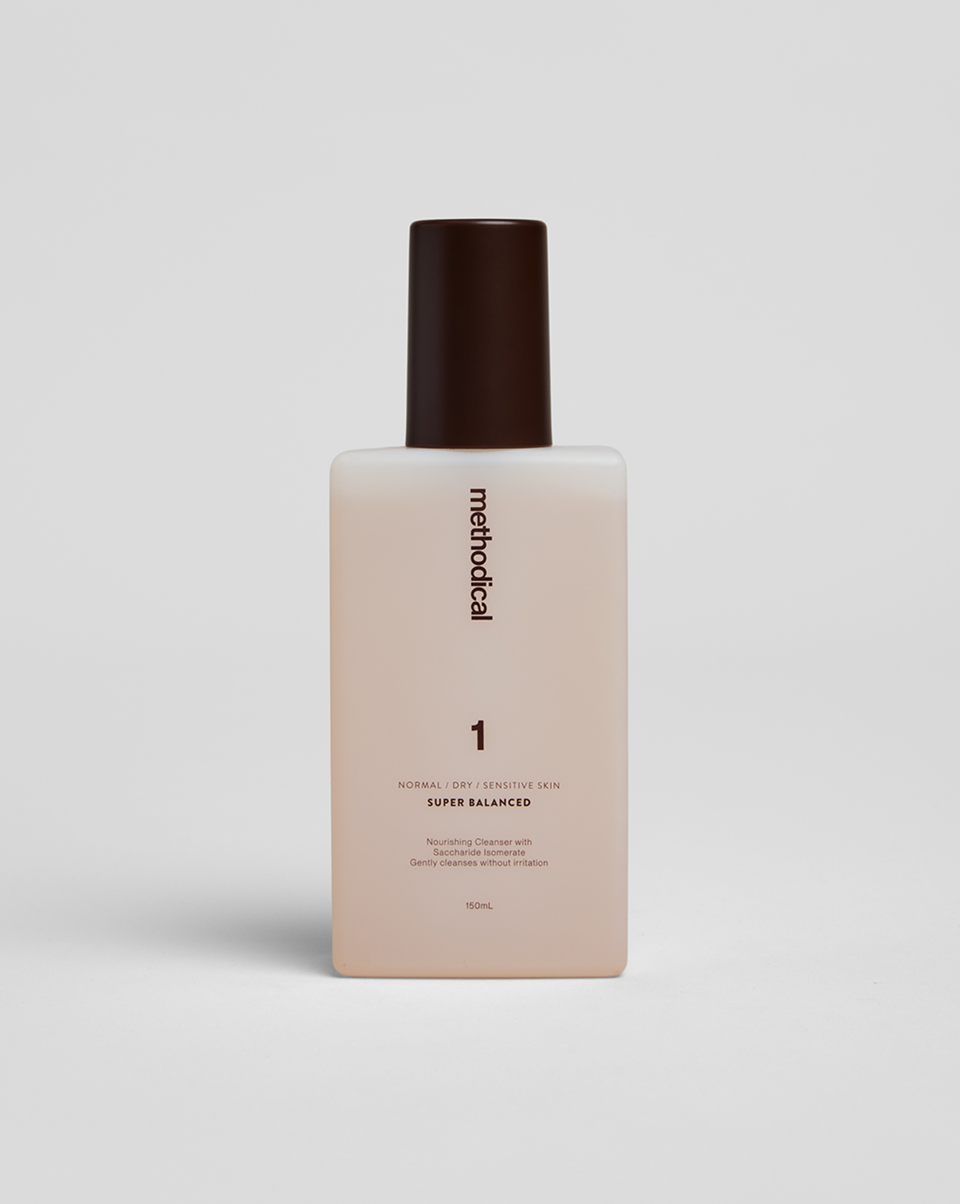
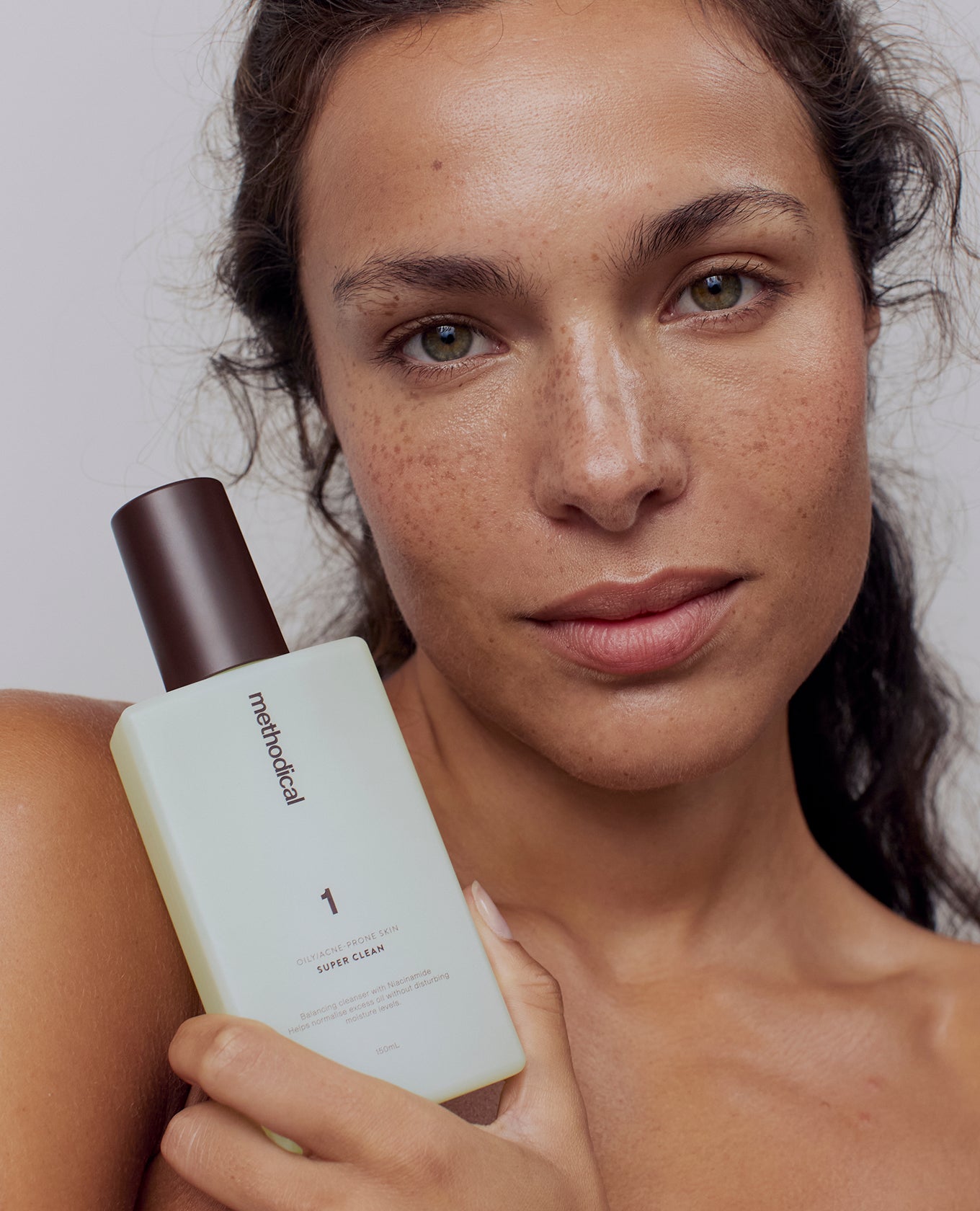
Methodical recommendation: Super Gentle Cleanser, formulated to clean thoroughly without disturbing the barrier, suitable for daily morning and evening use across most skin types.
How to use: A small amount, massaged for 30 to 60 seconds onto damp skin, rinsed with lukewarm (not hot) water. At night, if you’ve worn sunscreen or makeup, do this twice: first to remove what’s on the skin, second to actually cleanse it.
Step 2: Exfoliate
The job of exfoliation is to clear the buildup of dead surface cells that slows your skin’s natural turnover. Done well, it smooths texture, evens tone, and helps everything you apply afterwards absorb more evenly. Done badly, it’s one of the fastest ways to damage the barrier.
A good exfoliant is chemical, not physical (acids that loosen dead cells, rather than scrubs or brushes that abrade the surface), leave-on rather than a harsh wash-off, balanced to a low pH, and matched to your skin type. It should also be formulated alongside barrier-supportive ingredients, so it resurfaces the skin without stripping it. For most people, exfoliation is not a daily step.
What to look for: a gentle acid suited to your skin (lactic acid for dry or sensitive skin, glycolic for normal to combonation skin, salicylic for oily or congested skin), a leave-on gel-cream format rather than a high-strength rinse-off, and supporting ingredients like ceramides, hyaluronic acid and soothing actives in the same formula. Avoid physical scrubs and daily high-strength acids.
Methodical recommendation: the Methodical exfoliants are leave-on gel-creams matched to skin type. Super Soft (10% lactic acid) for dry and sensitive skin, Super Smooth (6% glycolic acid) for normal skin, and Super Clear (2% salicylic acid) for oily, congested or breakout-prone skin. Each pairs its acid with the same barrier-repair architecture used across the range, so the skin is supported while it’s resurfaced.
How to use: In the morning, after cleansing and before your Vitamins. Start once or twice a week and build gradually as your skin tolerates it, rather than using it every day. Always follow an exfoliation morning with SPF.
Step 3: Vitamins
The Vitamins step is where you deliver concentrated active ingredients and the small molecules that hydrate. This is where you address your specific concerns: dehydration, dullness, fine lines, pigmentation.
A well-formulated vitamins layer does several things at once. It hydrates with humectants like glycerin and hyaluronic acid; it supports the barrier with niacinamide or panthenol; and depending on the formula, it may include gentle actives that smooth, brighten, or refine.
What to look for: ingredients you recognise, at concentrations that are clinically effective but not provocatively high. More isn’t always better. A 30% vitamin C will not give you better results than a well-formulated 15%; it will, however, give you a much higher chance of irritation.
Methodical recommendation: the Vitamins Layer is two products applied in sequence, Super Firm (Vitamin C) for brightness and antioxidant support, then Super Repair (Niacinamide) to support the barrier and even tone. Both carry the same barrier-repair architecture used across the range, and together they’re designed to be the only serums most people need.
How to use: Applied to damp skin after exfoliating, Super Firm first, then Super Repair, each pressed in with the fingertips and given thirty seconds to absorb before the next step.
Step 4: Moisturise
This is the step most people get wrong. Either they skip it (usually because they have oily skin and think moisturiser will make it worse; it won’t, if it’s the right formula), or they buy something far heavier than their skin needs.
A moisturiser does three things, and a good one does all three:
Humectants (glycerin, hyaluronic acid, urea) draw water into the upper layers of the skin.
Emollients (squalane, ceramides, fatty acids) smooth and soften the surface and reinforce the lipid matrix between skin cells.
Occlusives (petrolatum, dimethicone, plant butters) form a thin film that slows water loss.
Without these working together, the water your serum delivered will evaporate within an hour. With them, your skin holds onto hydration through the day.
What to look for: ceramides, niacinamide, glycerin, squalane, panthenol. The right texture matters too: gel-cream for oilier skin, richer creams for drier skin.
Methodical recommendation: Super Supportive Moisturiser, combines humectants, ceramides, and a light occlusive layer to seal in hydration without weighing the skin down.
How to use: A pea-sized amount, pressed and smoothed across the face and neck while skin is still slightly damp from the previous step.
Step 5: Eyes (Night only)
The skin around the eyes is thinner and more delicate than the rest of the face, and it’s usually the first place to show dehydration, fine lines and fatigue. A dedicated eye product is formulated to be gentle enough for this area while still delivering hydration and targeted actives.
What to look for: lightweight hydration, barrier support, and gentle brightening or de-puffing actives, in a formula designed specifically for the eye area rather than a face product applied around the eyes.
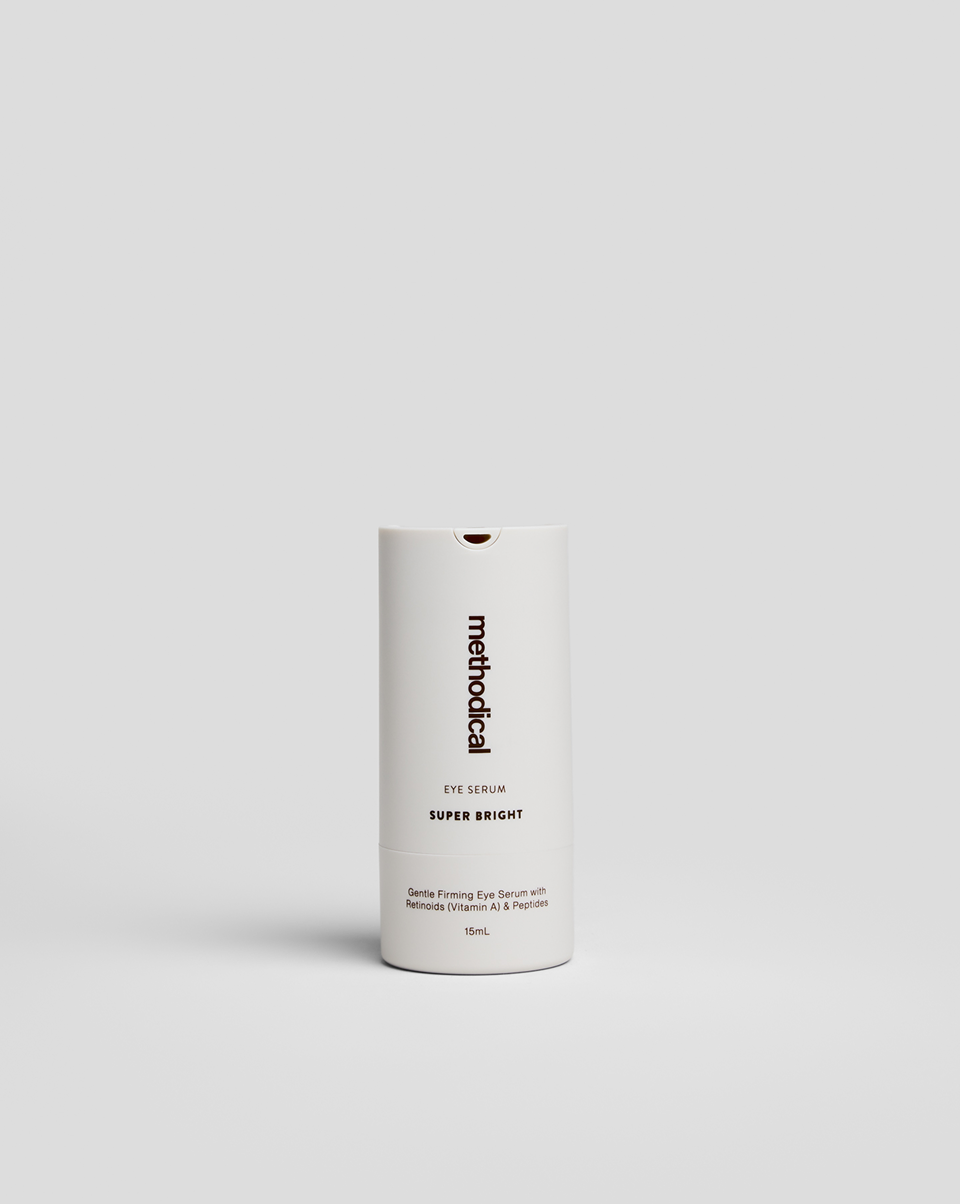
Methodical recommendation: Super Bright Eye Serum, formulated to hydrate, brighten and support the delicate skin around the eyes.
How to use: A small amount, patted gently around the orbital bone with the ring finger, in your evening routine. Avoid dragging or rubbing the skin.
Sunscreen (Morning Only)
If I could enforce a single skincare habit globally, it would be daily broad-spectrum sunscreen. The research here is unambiguous: UV exposure is responsible for the majority of visible skin ageing: the deep wrinkles, the sun spots, the loss of elasticity. It’s also the single biggest driver of skin cancer in this country.
What to look for: broad-spectrum protection (UVA and UVB), SPF 30 or higher, a formula you’ll actually wear every day. The best sunscreen is the one you reapply.
How to use: Two finger-lengths’ worth (about 1/4 teaspoon) for the face and neck, applied as the final step of your morning routine. Reapply every two hours when you’re outdoors, after swimming, or after heavy sweating.
If Methodical doesn’t carry an SPF in your region yet, choose any well-formulated broad-spectrum SPF 50; this is non-negotiable.
Got the framework? Next, how to tailor it to your skin: The Best Skincare Routine for Your Skin Type →
Dr Ceylan Yilmaz is a cosmetic doctor and medicinal chemist based in Melbourne. This article is general information, not a substitute for personalised medical advice. If you have a persistent skin concern, see your GP or dermatologist.