

Retinal vs Retinol: What’s the Difference?
4 min read By Dr Ceylan Yilmaz - Cosmetic Doctor & Medicinal Chemist
Retinol is one of the best-known ingredients in skincare, but retinal, also called retinaldehyde, is becoming increasingly popular.
Both are retinoids, meaning they are derivatives of vitamin A. They are used in skincare because of their ability to support skin renewal and improve visible signs of photoageing, including fine lines, uneven pigmentation and texture. [1]
The main difference between them is simple:
Retinal sits one step closer to retinoic acid (the prescription version) than retinol does.
How do retinol and retinal work?
Retinoic acid, only available with a prescription, is the biologically active form of vitamin A that interacts with receptors in skin cells.
Retinol and retinal must first be converted within the skin:
Retinol → Retinal → Retinoic acid
Retinol therefore requires two conversion steps, while retinal requires only one. [1]
This is why retinal is often considered a more direct cosmetic retinoid.
However, this does not mean that retinal behaves exactly like prescription tretinoin, which is retinoic acid itself.
Skin metabolism is regulated, and the effectiveness of any retinoid also depends heavily on the formulation.
Is retinal stronger than retinol?
You may have seen claims that retinal is "ten times stronger" than retinol. I prefer not to describe it that way.
A skincare ingredient cannot be judged only by the percentage written on the label.
Its performance depends on:
- Concentration
- Chemical stability
- Formulation
- Delivery into the skin
- Frequency of use
- Individual skin tolerance.
What we can say scientifically is that retinal has a biochemical advantage because it requires one fewer conversion step before becoming retinoic acid. [1]
Both retinol and retinal have evidence supporting their use in photoaged skin, although prescription tretinoin remains the most extensively studied topical retinoid. [1,2]
What does the research say about retinal?
Clinical studies have shown that retinaldehyde can improve visible signs of skin ageing.
In a randomised double-blind study, both 0.05% and 0.1% retinaldehyde improved skin texture and hydration after three months. The 0.1% formulation also significantly improved measured pigmentation. Both concentrations were reported as well tolerated. [3]
This combination of efficacy and tolerability is one reason retinal has become increasingly popular in modern skincare.
Why does formulation matter?
Retinoids are not particularly easy molecules to formulate.
They can be sensitive to light, oxygen and temperature, which can reduce their stability over time. [4]
So when I assess a retinoid product as a chemist, I don't just ask:
"What percentage of retinal is in it?"
I also ask:
"How stable is that retinal, and how effectively is it being delivered to the skin?"
This is where encapsulation becomes important.
What is encapsulated retinal?
Retinal is an effective vitamin A derivative, but it can be unstable and sensitive to light and oxidation. This is where delivery technology becomes important.
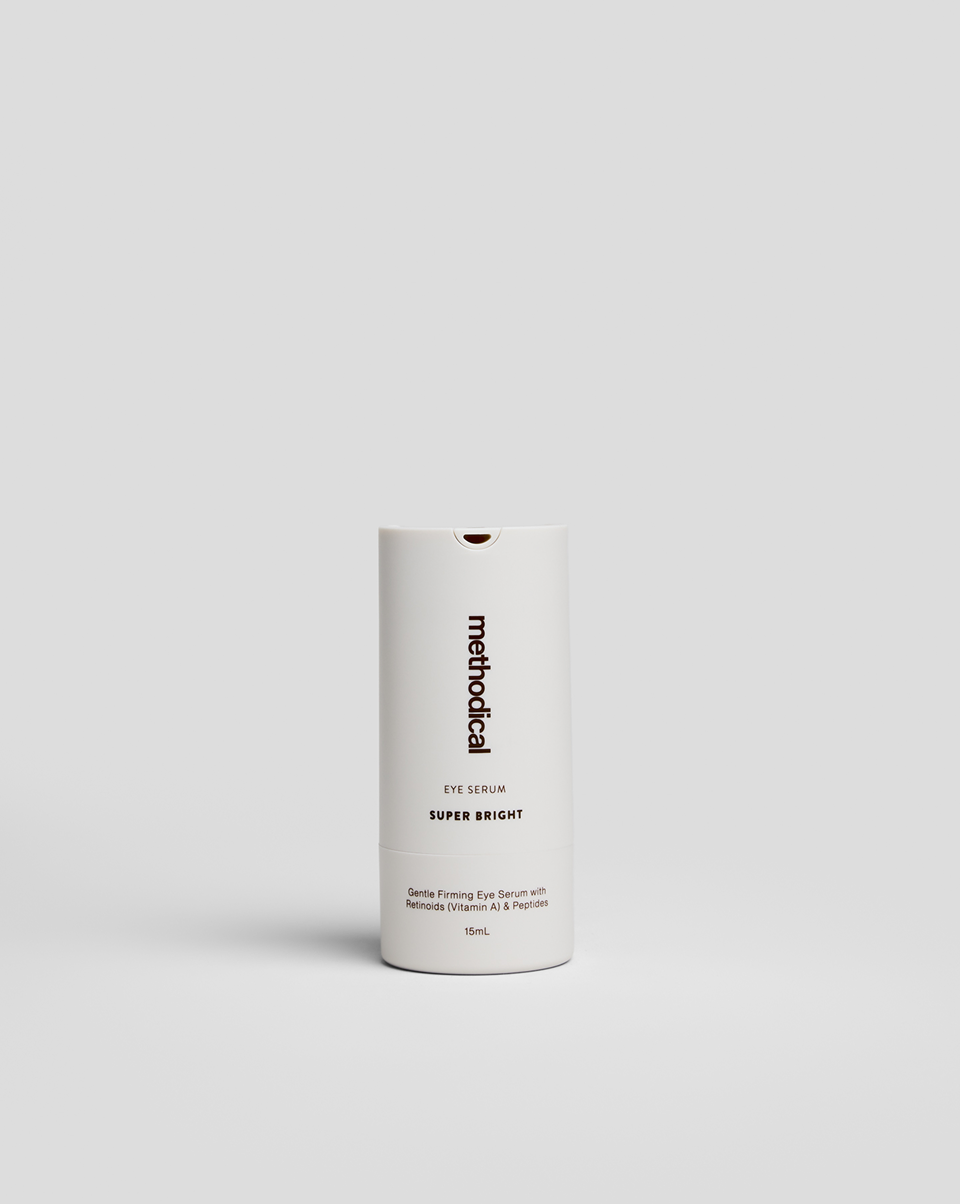
In Methodical Super Essential and Super Bright, we use Hydroxysomes® Retinaldehyde which uses nanoporous calcium phosphate particles to help stabilise retinaldehyde and support its controlled delivery into the skin.
This matters for two main reasons:
Improved stability
The delivery system helps protect retinaldehyde from degradation, so more of the active ingredient remains available when applied.
Controlled delivery
Rather than releasing free retinaldehyde all at once, the system is designed to provide more sustained delivery, helping balance efficacy with tolerability.
The calcium phosphate carrier also supplies calcium, which plays an important role in normal epidermal function and skin-barrier maintenance.
Encapsulation itself does not automatically make a retinal product better. The overall formulation, stability, concentration and tolerability still matter just as much as the delivery system.
Which one should you choose?
Both can be excellent ingredients.
Retinol may still be appropriate for people starting vitamin A or for those using a well-formulated product they tolerate comfortably.
Retinal may appeal to someone looking for a cosmetic retinoid that sits closer to retinoic acid in the vitamin A pathway.
But I would never choose a retinoid based on percentage alone.
I would look at:
The form of vitamin A, stability, delivery technology, supporting ingredients and how consistently your skin can tolerate the product.
Because the best retinoid is not necessarily the strongest one.
It is the one that delivers an effective amount of active ingredient in a stable formulation that you can use consistently.
Where Super Essential fits in
This philosophy is exactly why I formulated Methodical Super Essential as our nighttime Vitamin A step.
Rather than relying on traditional retinol alone, Super Essential combines encapsulated Retinaldehyde with Hydroxypinacolone Retinoate (HPR) and Bakuchiol, giving the formula multiple complementary pathways for supporting skin renewal.
Together, these ingredients are designed to help:
- Smooth the appearance of fine lines and uneven texture
- Support normal skin-cell renewal
- Improve the appearance of pigmentation and uneven tone
- support firmer, more resilient-looking skin
- Promote collagen-supporting pathways
- While maintaining Methodical's overall barrier-first approach to active skincare
For me, the aim was never simply to create the strongest possible Vitamin A product. It was to formulate a sophisticated retinoid system that combines effective delivery, complementary actives and long-term tolerability -because consistency is ultimately what allows retinoids to deliver their best results.
References
[1] Mambwe B, Mellody KT, Kiss O, et al. 2024. International Journal of Cosmetic Science. Cosmetic retinoid use in photoaged skin: A review of the compounds, their use and mechanisms of action
[2] Milosheska D, Roškar R. 2022. Advances in Therapy. Use of Retinoids in Topical Antiaging Treatments: A Focused Review of Clinical Evidence for Conventional and Nanoformulations
[3] Kwon HS, Lee JH, Kim G, Bae J. 2018. Journal of Cosmetic Dermatology. Efficacy and safety of retinaldehyde 0.1% and 0.05% creams used to treat photoaged skin
[4] Zhong J, Zhao N, Song Q, Du Z, Shu P. 2024. Journal of Cosmetic Dermatology. Topical retinoids: Novel derivatives, nano lipid-based carriers, and combinations to improve chemical instability and skin irritation
[5] Singpanna K, et al. 2024. Polymers. Alpha-Tocopherol-Infused Flexible Liposomal Nanocomposite Pressure-Sensitive Adhesive: Enhancing Skin Permeation of Retinaldehyde
[6] Kim J, Kim J, Lee YI, et al. 2021. Journal of Cosmetic Dermatology. A pilot study evaluating the efficacy and safety of retinaldehyde-loaded niosomes against mild-to-moderate acne