


Can Sensitive Skin Use Exfoliants? Yes, Here’s Why
By Dr Ceylan Yilmaz, Cosmetic Doctor & Medicinal Chemist
This is one of the most common questions I get in clinic. People who flush easily, who react to new products, who have rosacea or who have spent years rebuilding a damaged barrier, they assume exfoliation is closed off to them. The textures they associate with exfoliation are scrubs, brushes, peels, and that uncomfortable tingling sensation. It makes sense that sensitive skin would want to avoid all of that.
But the question itself contains a category error. “Exfoliation” isn’t one thing. It covers a wide range of products and treatments, some of which are genuinely too harsh for reactive skin and some of which are gentler than your face wash. The honest answer to “can sensitive skin use exfoliants?” is: yes, absolutely, but the type, the format, and what else is in the bottle all matter enormously.
This article explains what’s actually happening when you exfoliate, why the right kind of chemical exfoliant can quietly improve sensitive skin rather than damage it, and why the Methodical Method’s morning placement of exfoliation works particularly well for reactive skin.
The Short Answer
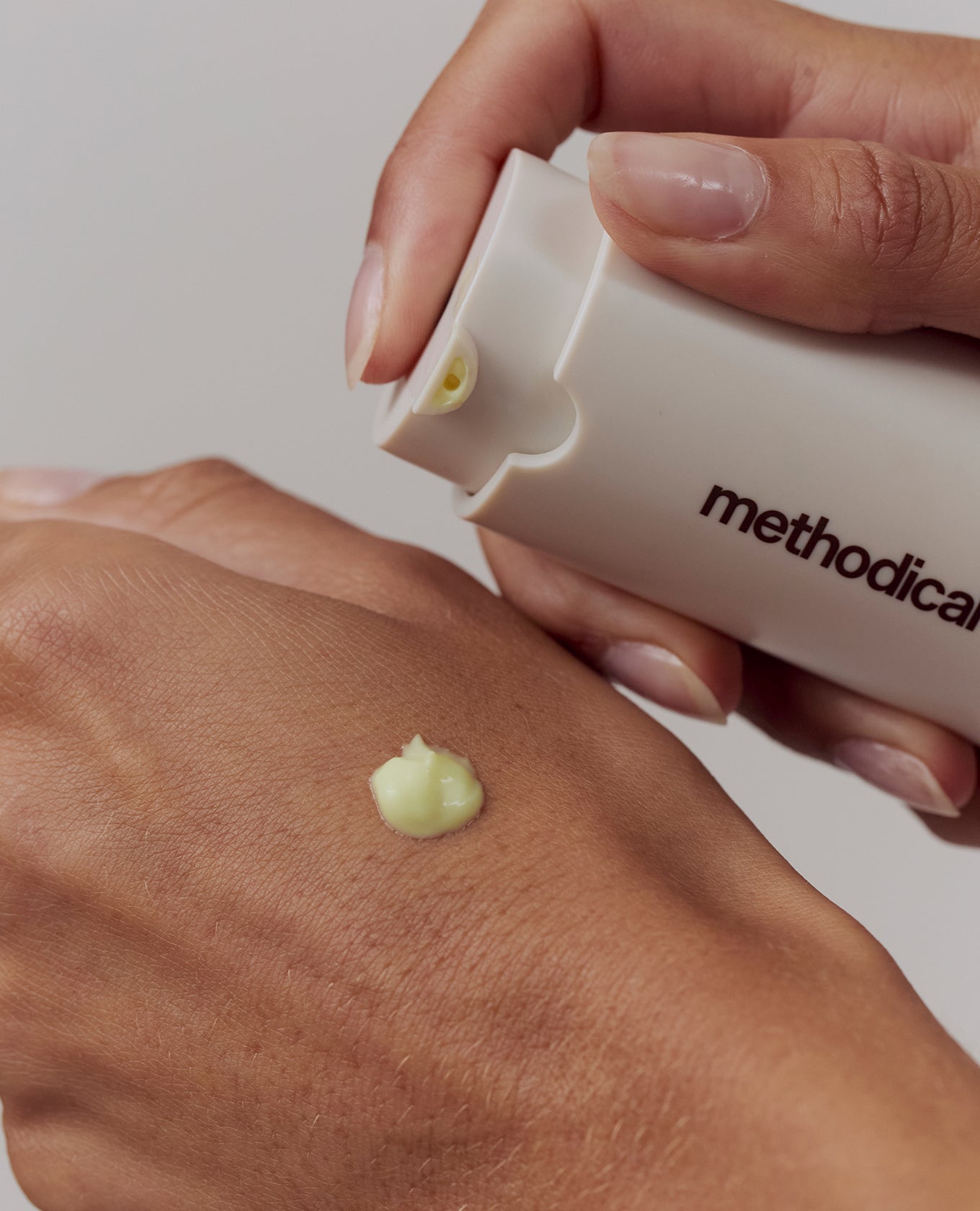
Yes, sensitive skin can use exfoliants, provided you choose a gentle, leave-on chemical exfoliant that’s formulated alongside barrier-repair ingredients, introduce it slowly, avoid physical scrubs, and follow it with daily SPF. For most sensitive skin, my first recommendation is Methodical Super Soft 10% Lactic Acid Exfoliant, a leave-on gel-cream formulated with Methodical’s “Soothing Shield” of Panthenol, Allantoin and Bisabolol, plus skin-identical lipids and a four-form Hyaluronic Acid complex. As part of the Methodical Method, it’s used in the morning, between cleansing and the Vitamins Layer, and finished with SPF. The morning placement plus the barrier-repair architecture is what makes daily exfoliation viable for sensitive skin.
The rest of this article explains why each of those conditions matters, and why that combination of formula and protocol is the difference between an exfoliant that suits sensitive skin and one that wrecks it.
Why Sensitive Skin Needs Exfoliation Too
Your skin renews itself constantly. New cells form in the lower epidermis, mature as they move upward, and shed from the surface in a process called desquamation. A complete turnover of the stratum corneum, the outermost working layer of your skin, takes around two weeks in healthy young skin, and slows progressively with age, sun damage, and certain skin conditions.
When this shedding slows, dead cells accumulate. The skin looks duller, feels rougher, and absorbs other skincare less effectively. Pores can become congested, fine lines become more visible, and pigmentation lingers longer than it should. None of these problems are exclusive to robust skin. In fact, sensitive skin often has impaired barrier function and slower repair processes, which means uneven turnover and surface roughness are very common in this group.
The clinical reality is that sensitive skin frequently benefits more from well-chosen exfoliation than oily, robust skin does, provided we choose the right tool for the job, and we time it correctly.
Why Physical Exfoliants Are the Wrong Choice for Sensitive Skin
Most of the bad experiences my sensitive-skinned patients describe come from physical exfoliation. That includes:
- Granular scrubs (sugar, salt, walnut shell, jojoba beads, microbeads)
- Cleansing brushes and silicone tools
- Konjac sponges, muslin cloths used aggressively
- At-home microdermabrasion devices
The problem is mechanical. Physical exfoliants work by abrading the surface of the skin. On sensitive skin, where the barrier is already compromised, mechanical disruption causes microscopic tears, triggers inflammation, increases transepidermal water loss, and often leads to a flare-up of whatever sensitivity the person was trying to manage in the first place.
If you have sensitive skin, my general advice is to retire the scrubs and brushes altogether. There’s almost always a better option.
Why Leave-On Chemical Exfoliants Are Different
Chemical exfoliation works by a different mechanism altogether. Instead of physically scraping cells off the surface, hydroxy acids loosen the bonds (called corneodesmosomes) that hold dead cells together at the top of the stratum corneum. When those bonds are broken, the cells shed naturally, without abrasion, without inflammation, and without disturbing the deeper, living layers of the skin.
The key distinction within chemical exfoliation is wash-off versus leave-on:
Wash-off acid cleansers and toners sit on the skin for seconds, then rinse away. Concentrations are usually higher to compensate for the short contact time, which is harsher on sensitive skin.
Leave-on chemical exfoliants stay on the skin and work over hours. Because the contact time is so much longer, the concentrations can be lower, and the experience much gentler, while still delivering meaningful results.
For sensitive skin, leave-on is almost always the better choice. This is also why Methodical’s exfoliants are exclusively leave-on gel-creams rather than toners or rinse-off acid washes. The format gives you control over how much exfoliation is actually happening.
Why the Methodical Method Exfoliates in the Morning
Most skincare advice you’ll read says to exfoliate at night. That advice is correct for most acid products on most skin: they make the skin photosensitive, and putting them on before sun exposure is asking for irritation, pigmentation and damage.
The Methodical protocol does it differently for three reasons.
First, the formula isn’t a plain acid product. Super Soft pairs the 10% lactic acid with a Soothing Shield (Panthenol, Allantoin, Bisabolol), four forms of hyaluronic acid, skin-identical lipids, and nourishing seed oils. The irritation that ordinary morning acids cause comes from the acid stripping the barrier; this formula is rebuilding the barrier in the same step. That changes the daytime safety equation entirely.
Second, the Methodical Method finishes the morning routine with SPF. The photosensitivity concern is fully addressed by broad-spectrum SPF 30 or higher applied as the final step. For sensitive skin, this is non-negotiable, and the article assumes you’re doing it.
Third, morning exfoliation prevents stacking too many actives at night. In the Methodical evening routine, the Vitamins Layer includes Super Essential (Vitamin A + Bakuchiol), which is itself a cell-turnover active. Placing exfoliation in the morning means you’re never asking sensitive skin to handle a retinoid and an exfoliating acid on the same evening, which is one of the fastest ways to overload reactive skin.
For sensitive skin specifically, this protocol actually has more in its favour than the conventional “exfoliate at night” advice. It just requires the right formula and absolute discipline with SPF.
Dr Ceylan Yilmaz is a cosmetic doctor and medicinal chemist based in Melbourne. This article is general information, not a substitute for personalised medical advice. If you have a persistent skin concern, a diagnosed skin condition like rosacea or eczema, or you’re unsure where to begin, please consult your GP, dermatologist or a qualified cosmetic doctor.